e u r o p e

| home |

| africa | america | asia | east asia | EUROPE | oceania | south east asia |

| commemorative | hybrid | polymer | australia |

| a | b | c | d | e | f | g | h | i | j | k | l | m | n | o | p | q | r | s | t | u | v | w | x | y | z |


"no borrowed scans here nor i cut and pasted from other web sites. all notes displayed here are mine. i have 100% ownership of all the banknotes posted here!"

Showing posts with label Scotland - Bank of Scotland. Show all posts

...Scotland, Bank of Scotland Limited - £20 Polymer Dated 2021 Polymer

Scotland

Bank of Scotland Limited
(Established 17.07.1695, First bank to issue banknote in Scotland)
(part of the Lloyds Banking Group)
Currency : Pound Sterling (GBP)


Here I have the latest 20 pounds polymer note dated 16th August 2021. This series was first issued in early 2020 (dated 1st June 2019). The designs on this note (front and back) are still the same, except for the new date and also the titles of the signatures on the note.

Twenty Pounds
 
Chief Executive Officer - Charles Alan Nunn (since 2021)
Treasurer - Sir Robin Francis Budenbery (since 2021)
Date - 16th August 2021
Dimensions - 140mm x 73.5mm 
 
Front - The face of Sir Walter Scott (b.1771-1832). He was a Scottish novelist, poet and historian. In the center is the Bank of Scotland Headquarters building on The Mound. The building is printed with 9 windows, the front entrance and a dome all with see-through features. These features also act as an anti-counterfeit “window effect”.
 
Back - The main feature is the Forth bridge. In the background you can see Queensferry Crossing bridge. There are three bridges built across the Firth of Forth linking between Edinburgh, at South Queensferry, and Fife, at North Queensferry. The distance between these bridges is about 1 to 1.5 miles. These bridges are Queensferry Crossing bridge (2017), Forth Road bridge (1964) and Forth bridge (1889).
 
 
@71

..Scotland, Bank of Scotland - £100 Polymer Note 2022 (and £50 Dated 2020 Polymer - Matching Serial Numbers)

Scotland
(Alba)

Bank of Scotland Limited
(Established 17.07.1695, First bank to issue banknote in Scotland)
Currency : Pound Sterling (GBP)
 
This is the fifth and the final of the polymer banknote series for Bank of Scotland, first introduced in 2016. This note was introduced on 05.05.2022. At the time of this writing, the Bank of Scotland is the only commercial bank that has issued the polymer series in full set. The other issuing banks, like the Clydesdale Bank have issued up to £20 polymer note, whilst The Royal Bank of Scotland have released a £50 polymer note. 

As this is the first of the polymer series with the denomination of £100, and unlike all the previous issued polymer notes, which were all related to the Bridge series, the design on the back for this new note is dedicated to Dr Flora Murray, who was a physician. However, on the website of the Bank of Scotland, this polymer note is still referred to the Bridge series, but no bridge can be found on the design of the note, both front and back. The last paper note for the £100 featured the design of the Kessok bridge.

This is the first polymer banknote issued with the denomination of £100 in the United Kingdom. It would be interesting to find out why the Bank of Scotland decided to issue the £100 note, whilst all other banks, including the Bank of England have not? Even in Northern Ireland, only the Ulster Bank have only released a £50 polymer note so far. The Bank of Scotland have the history of printing £100 banknotes since 1894, but with modern technology whereby many transactions are now done via EFTPOS, one would expect the demand for such high denomination may not be as high as before, and as such, less would be required. It would be interesting to see the next reprint for this note. The colour of this polymer £100 note is printed predominately in green, instead of red like the previous cotton based paper £100 notes.
 
You must be wondering why so far, only the FM prefix notes for this denomination are available for sale. The bank has also printed this denomination with the AA first prefix, but only released 93 pieces for sale via Spink Auction. Based on the auction, solid notes with numbers like AA 111111, AA 222222, AA 333333 etc were also sold. Therefore, one would assume that this series is printed with both AA and FM prefixes in full, unless those AA prefix were specifically printed for the charity auction purpose. Time will tell if we get to see the AA prefix notes with the same date are released for circulation. 
 
This note honored Dr Flora Murray with her name in initials FM prefix.
 
One Hundred Pounds 154mm x 82mm
 
Sir Walter Alva Scott (b.1771-1832) Scottish historical novelist, poet, playwright, and historian, Bank of Scotland Headquarters on The Mound
 
Front - The portrait of Sir Walter Alva Scott (b.1771-1832), who was a Scottish historical novelist, poet, playwright, and historian. In the middle is the Bank of Scotland Headquarters on The Mound, a man-made slope situated in central Edinburgh which connects Edinburgh’s New and Old Towns. Ten tiny see-through windows are also incorporated on the design of the building, just like those polymer banknotes issued previously. On top of the bank's headquarters is an image of the Four Thistles, and on the bottom is the bank's crest. On the left of the note is the holographic foil stripe featuring the Mound and blow with the image of Dr Flora Murray. This note is printed with her initials - 'FM'.
 
Signatures
Chief Executive Officer Lloyds Banking Group - Charlie Alan Nunn (since August 2021)
Governor - Robin Francis Budenberg (since January 2021)
Printer - De La Rue
Dimensions - 154mm x 82mm
 
This is the first note bearing the CEO's signature of Charlie Alan Nunn, replacing Antonio Mota de Sousa Horta-Osorio, whose signatures appeared on Bank of Scotland's banknotes (paper and polymer) issued since 2011.
 
Back - The portrait of Dr Flora Murray (b.1869-1923). On her portrait, it has printed with the words - Scottish medical Pioneer; and them followed by her name and her birth year and the year she died. Dr Murray was a physician, and died in 1923 at the age of 54. In 2023, it would be the 100th year of her death. Dr Murray was the suffragette and medical pioneer who helped and care for many wounded soldiers during the first World War. This note is dedicated to her work in medicine and in women's right. The portrait on this note was painted by Francis Edgar Dodd, who was a portrait painter, landscape artist and print maker. On the left of the note is an image of female stretcher-bearers outside Endell Street Military Hospital in Convent Garden, central London. This hospital was opened in May 1915, and was a First World War military hospital, and was closed in December 1919 and later demolished.
 
Dr Flora Murray (b.1869-1923)

Fifty Pounds
Sir Walter Alva Scott (b.1771-1832) Scottish historical novelist, poet, playwright, and historian, Bank of Scotland Headquarters on The Mound

Please click on the link here to view my previous post for this £50 dated 2020 polymer note.

Falkirk Wheel built in 1875, two horses pulling a canal barge, two large kelpies

Footnote:
On 05.05.2022, Spink of London auctioned off 93 x £100 banknotes with AA and FM prefixes, plus two sheets of 40-in-1, with a total lots of 188. The single notes are mainly those with low serial numbers from the first note to #50, and then followed by other numbers, fancy and solid notes. The first note with AA 000001 was sold for £17,000 plus buyer's commission of 20% plus VAT. The first note for the FM prefix, FM 000001 was sold for only £4,800.

..Scotland, Bank of Scotland - 50 Pounds Polymer Bridge Series 2021

Scotland
(Alba)

Bank of Scotland Limited
(Established 17.07.1695, First bank to issue banknote in Scotland)
Currency : Pound Sterling (GBP)
 
This is the fourth polymer note issued since the polymer banknote series first introduced in 2016.
 
On the front it features: -
Portrait of Sir Walter Scott (b.1771-1832); 
Bank of Scotland Headquarters on The Mound;
Bank of Scotland Crest; 
Spark® denomination numeral "50"; 
Image of Four Thistles;
Holographic foil stripe featuring image of ‘Prosperity’ below the pediment of the Mound with a thistle motif in the background; 
Bank of Scotland name and logo

The design on the front is basically the same as the £20 polymer banknote issued in 2019. As expected, the new note features the portrait of Sir Walter Alva Scott (b.1771-1832), who was a Scottish historical novelist, poet, playwright, and historian. In the middle is the Bank of Scotland Headquarters on The Mound, a man-made slope situated in central Edinburgh which connects Edinburgh’s New and Old Towns. Ten tiny see-through windows are also incorporated on the design of the building, just like the £20 polymer banknote.
 
On the back, it retains the design of the Falkirk Wheel, which was also featured on the previous paper note of £50, first issued in the 2007 series. However, the design of the Falkirk Wheel is taken from a different angle and as such not the same. The Falkirk Wheel is a rotating boat lift connecting two canals. The two canals connected by the Falkirk are the Forth and Clyde Canal and the Union Canal. The Union Canal is about 11 meters higher than the Forth and Clyde Canal. This wheel was built in 1875 and is the only rotating boat lift, not only in Scotland, but in the world. The Falkirk Wheel is situated in central Scotland, about half an hour drive from Glasgow (northeast of Glasgow).
 
Underneath the wheel, is showing two horses pulling a canal barge. The background also shows two large kelpies, A kelpie is a shape of a horse and it said to be a shape-changing aquatic spirit of Scottish legend. Two of these 30-meter high horse-head sculptures are situated in Falkirk as a tourist attraction. It is also said that kelpies haunt rivers and streams in the shape of a horse. In the top left corner of the polymer note, it also features the poem Steam Barge, written by William Muir. The design of this note is the continuation of the bridge series, introduced since 2007.

The £50 banknote is not a common denomination of banknotes for the Bank of Scotland and this denomination was only first introduced in 1995, celebrating the tercentenary of Bank of Scotland 1695-1995. Traditionally this note is printed with green colour, however, for this new £50 it is printed in red. Should the bank decided to release a new £100 polymer note at a later date, we will expect this to have a new colour instead of red.

Whilst this note is dated 01.06.2020, it was introduced to the public on 01.07.2021. In addition to the normal release, the bank also packed together 750 sets of individual notes all with AA prefix and sold them for £100 each. Profits generated from the sales are all donated to charities. The note that I have posted here came from the presentation pack.

Signatures
Governor - Antonio Mota de Sousa Horta-Osorio
Treasurer - Philip Grant
Dimensions - 146mm x 77mm
 
Fifty Pounds (Polymer)
Sir Walter Alva Scott (b.1771-1832) Scottish historical novelist, poet, playwright, and historian, Bank of Scotland Headquarters on The Mound
Falkirk Wheel built in 1875, two horses pulling a canal barge, two large kelpies
 
 Presentation Cover Side 1
Inside cover

Presentation Cover Side2
Back Cover


...Scotland, Bank of Scotland Limited - £20 Polymer and Queensferry Crossing over the Firth of Forth Commemorative Collectors Set

Alba / Scotland

Bank of Scotland Limited
(Established 17.07.1695, First bank to issue banknote in Scotland)
Currency : Pound Sterling (GBP)

On 07.11.2019, the Bank of Scotland unveiled two new £20 polymer notes. The theme for these new notes are the same as the current "Bridge and Viaducts" series. This series was first issued in 2007 with a full set from £5 to £100. These two new polymer notes were released to the public on 27.02.2020, consisting of one normal and one commemorative note.

On 10.03.2020, the Bank of Scotland released the two new polymer notes of £20 in a presentation pack with matching serial numbers. These are purposely put together as a pair with matching serial numbers. The two notes issued are one for general circulation type with the first prefix of AA and the other one is a limited commemorative edition with the prefix of QC, celebrating the Queensferry Crossing bridge. These notes have a general low serial numbers range, and it is believed that the first batch released with serial numbers range from 400 to 600 and then 900 and beyond (presumably but not confirmed). Obviously with 1000 sets to be issued, not all are in sequential order. These sets are put together for a good cause and sold at a premium with all profits raised donated to the Bank's group charity.

Front
Portrait of Scottish novelist and poet Sir Walter Scott (b.1771-1832);
Bank of Scotland Headquarters on The Mound, a man-made slope situated in central Edinburgh which connects Edinburgh’s New and Old Towns;
Bank of Scotland Crest;
Spark® denomination numeral "20";
Image of Four Thistles;
Holographic foil stripe featuring image of ‘Fame’ below the pediment of the Mound with a thistle motif in the background;
Bank of Scotland name and logo.

The design on the front for these two notes are the same but not the same as those previous two polymer notes issued i.e. £5 and £10. Unlike those earlier polymer notes issued, this £20 is printed with the holographic depth stripe.

Back
Normal Note
Vignette of the famous Forth Bridges and wording ‘Forth Bridge’;
Lyrics from the traditional ballad ‘Far Over the Forth’;
Bank of Scotland Headquarters on The Mound;
A Thistle;
Holographic foil stripe featuring an image of ‘Fame’ below the pediment of the mound, with a thistle motif in the background;
Bank of Scotland name and logo.

The Queensferry Crossing bridge is also visible in the background. The distinctive red Forth Bridge, a cantilever railway bridge crossing the Firth of Forth which is located nine miles west of the city of Edinburgh. The construction for The Forth Bridge was started in 1882 and completed in 1889 and is one of the many famous man made landmarks in Scotland. This bridge is for rail traffic only. The Forth Bridge has a length of 8,094 feet and double tracks elevated to 150 feet above the water level at high tide. This bridge was designed by the English engineers Sir John Fowler and Sir Benjamin Baker. The Forth bridge was listed as a World Heritage Site by UNESCO in July 2015.

Commemorative Note
Vignette of the Queensferry Crossing with the Forth Bridges in the background, and the wording ‘Queensferry Crossing’;
Lyrics from the traditional ballad ‘Far Over the Forth’;
Bank of Scotland Headquarters on The Mound;
A Thistle;
Holographic foil stripe featuring image of ‘Fame’ below the pediment of the mound, with a thistle motif in the background;
Bank of Scotland name and logo.

This commemorative note is issued to celebrate the Queensferry Crossing bridge which was completed in 2017. Unlike the Forth Bridge, this Queensferry Crossing bridge is for vehicle traffic only. This bridge was built alongside the Forth Bridge. This is the third bridge linking South Queensferry to Fife and was opened to traffic in 2017. This is a limited commemorative issue printed with the special prefixes of QC (Queensferry Crossing) and QF (Queensferry) only.

Both notes are printed with see-through tiny windows or an anti-counterfeit “window effect” on The Mound and a holographic depth stripe at the top of the foil, showing a “Northern Lights effect” when the note is tilted.

Below is a picture of the three bridges built across the Firth of Forth linking between Edinburgh, at South Queensferry, and Fife, at North Queensferry. The distance between these bridges is about 1 to 1.5 miles. These bridges are (L-R) Forth bridge (b.1889), Forth Road bridge (b.1964) and Queensferry Crossing bridge (built 2017). These 3 bridges are famous landmarks in Scotland.
a bird's eye view of all 3 bridges, courtesy of visitscotland.com
These two notes are both dated 1st June 2019.

Governor - Antonio Mota de Sousa Horta-Osorio
Treasurer - Philip Grant
Imprinter - De La Rue
Size - 139mm x 73mm

Twenty Pounds (Normal first prefix note)
Dated 2019, Prefix AA
Reverse
Twenty Pounds (Commemorative note with QC prefix)
Dated 2019, Prefix QC
Reverse
Folder Front Cover

Scotland, Bank of Scotland Limited - £20 Polymer Commemorative Note Queensferry Crossing over the Firth of Forth

Alba / Scotland

Bank of Scotland Limited
(Established 17.07.1695, First bank to issue banknote in Scotland)
Currency : Pound Sterling (GBP)

On 07.11.2019, the Bank of Scotland unveiled two new £20 polymer notes. One is for general circulation and the other one is to commemorate the Queensferry Crossing bridge which was built in 2017. Both of these notes were released to the public on 27.02.2020. I have earlier posted the normal note and now I am posting the commemorative note here.

The release of these two notes were first announced by the bank on 07.11.2019. The theme for this new polymer note is the "Bridge" series, which is the continuation of the current series, first issued in 2007.

Here I have posted the commemorative notes with the two prefixes of QC and QF.

Front
Portrait of Scottish novelist and poet Sir Walter Scott (b.1771-1832);
Bank of Scotland Headquarters on The Mound, a man-made slope is situated in central Edinburgh which connects Edinburgh’s New and Old Towns;
Bank of Scotland Crest;
Spark® denomination numeral "20";
Image of Four Thistles;
Holographic foil stripe featuring image of ‘Fame’ below the pediment of the Mound with a thistle motif in the background;
Bank of Scotland name and logo.

Back
Vignette of the Queensferry Crossing with the Forth Bridges in the background, and the wording ‘Queensferry Crossing’;
Lyrics from the traditional ballad ‘Far Over the Forth’;
Bank of Scotland Headquarters on The Mound;
A Thistle;
Holographic foil stripe featuring image of ‘Fame’ below the pediment of the mound, with a thistle motif in the background;
Bank of Scotland name and logo.

As mentioned earlier, this commemorative note is issued to celebrate the Queensferry Crossing bridge. Unlike the Forth Bridge, this Queensferry Crossing bridge is for vehicle traffic only. This bridge was built alongside the Forth Bridge. This is the third bridge linking South Queensferry to Fife and was opened to traffic in 2017. This is a limited edition with the special prefixes of QC (Queensferry Crossing) and QF (Queensferry) only.

Just like the normal £20 Polymer note, this note is also printed with see-through tiny windows or an anti-counterfeit “window effect” on The Mound and a holographic depth stripe at the top of the foil, showing a “Northern Lights effect” when the note is tilted.

There are three bridges built across the Firth of Forth linking between Edinburgh, at South Queensferry, and Fife, at North Queensferry. The distance between these bridges is about 1 to 1.5 miles. These bridges are Queensferry Crossing bridge (2017), Forth Road bridge (1964) and Forth bridge (1889). The Forth bridge was listed as a World Heritage Site by UNESCO in July 2015.

The note is also printed with the date of 1st June 2019. It is believed that only up to 1.0M pieces each are issued for the commemorative notes with QC and QF prefixes.

Governor - Antonio Mota de Sousa Horta-Osorio
Treasurer - Philip Grant
Imprinter - De La Rue
Size - 139mm x 73mm

Twenty Pounds
Dated 2019, Sir Walter Scott, Bank of Scotland Headquarters on The Mound
Reverse - Vignette of the Queensferry Crossing with the Forth Bridges in the background
Twenty Pounds
Dated 2019, Sir Walter Scott, Bank of Scotland Headquarters on The Mound
Reverse - Vignette of the Queensferry Crossing with the Forth Bridges in the background

...Scotland, Bank of Scotland Limited - £20 Polymer Dated 2019 Normal Polymer Circulating Note

Alba / Scotland

Bank of Scotland Limited
(Established 17.07.1695, First bank to issue banknote in Scotland)
Currency : Pound Sterling (GBP)

This is the latest issue of a new £20 polymer note which was first announced on 07.11.2019, together with another £20 polymer commemorative note celebrating the Queensferry Crossing bridge which was opened to traffic in 2017. These two notes were released to the public on 27.02.2020. The theme for this new note is the "Bridge" series, which is the continuation of the current series, first issued in 2007.

Here I have only posted the normal polymer note issued.

Front
Portrait of Scottish novelist and poet Sir Walter Scott (b. 1771-1832);
Bank of Scotland Headquarters on The Mound, a man-made slope is situated in central Edinburgh which connects Edinburgh’s New and Old Towns;
Bank of Scotland Crest;
Spark® denomination numeral "20";
Image of Four Thistles;
Holographic foil stripe featuring image of ‘Fame’ below the pediment of the Mound with a thistle motif in the background;
Bank of Scotland name and logo.

The design on the front is unlike the previous two polymer notes issued. Unlike those earlier polymer notes issued, this £20 is printed with the holographic depth stripe.

Back
Vignette of the famous Forth Bridges and wording ‘Forth Bridge’;
Lyrics from the traditional ballad ‘Far Over the Forth’;
Bank of Scotland Headquarters on The Mound;
A Thistle;
Holographic foil stripe featuring an image of ‘Fame’ below the pediment of the mound, with a thistle motif in the background;
Bank of Scotland name and logo.

The Queensferry Crossing bridge is also visible in the background. The distinctive red Forth Bridge, a cantilever railway bridge crossing the Firth of Forth which is located nine miles west of the city of Edinburgh. The construction for The Forth Bridge was started in 1882 and completed in 1889 and is one of the many famous man made landmarks in Scotland. This bridge is for rail traffic only. The Forth Bridge has a length of 8,094 feet and double tracks elevated to 150 feet above the water level at high tide. This bridge was designed by the English engineers Sir John Fowler and Sir Benjamin Baker. The Forth bridge was listed as a World Heritage Site by UNESCO in July 2015.

This note is printed with see-through tiny windows or an anti-counterfeit “window effect” on The Mound and a holographic depth stripe at the top of the foil, showing a “Northern Lights effect” when the note is tilted.

There are three bridges built across the Firth of Forth linking between Edinburgh, at South Queensferry, and Fife, at North Queensferry. The distance between these bridges is about 1 to 1.5 miles. These bridges are Queensferry Crossing bridge (2017), Forth Road bridge (1964) and Forth bridge (1889).

This note is printed with the date 1st June 2019.

Governor - Antonio Mota de Sousa Horta-Osorio
Treasurer - Philip Grant
Imprinter - De La Rue
Dimensions - 139mm x 73mm

Twenty Pounds
Dated 2019, Sir Walter Scott, Bank of Scotland Headquarters on The Mound
Reverse - Vignette of the famous Forth Bridges, Bank of Scotland Headquarters on The Mound

Scotland, Bank of Scotland - £50 Dated 2016 Paper Banknote

Alba / Scotland
Bank of Scotland

Apart from the polymer series, I believe this is the only paper banknote issued with the year date of 2016. This Bridge series was first issued in 2008 (dated 2007) and this is the third reprint since then (2007, 2009, 2011 and 2016). The design is still the same except that it has a new date of 29.03.2016 printed on the note.

Signatures
Governor - Antonio Mota de Sousa Horta-Osorio
Treasurer - Philip Grant

Fifty Pounds
Dated 2016, P127e
Reverse

...Scotland, Bank of Scotland - £10 Dated 2016 Polymer Experiment/Test Note Prefix XX

Alba / Scotland - Bank of Scotland

This note dated 01.06.2016 was first issued on 10.10.2017 for general circulation. The note posted below has a special prefix of XX. I believe this note was printed for experience/testing purposes including ATM dispensing, washing, soiling etc. However, I have no confirmation on this, and therefore I could be wrong. Only the bank can tell us why.

Ten Pounds
Dated 2016, Prefix XX
Reverse

...Scotland, Bank of Scotland - Single £10 2016 and £5 & £10 2016 Two Notes Polymer Series Presentation Folders

Scotland
Bank of Scotland

Like the previous £5 presentation folder issue, this is also a presentation folder for the £10 polymer note issued on 10.10.2017. This time, two varieties were made available to the collectors; -

One-note folder - This comprises the £10 polymer note only. Only 2000 sets issued with serial numbers ranging from AA 003001 to AA 005000.

Two-note folder - This folder comes with the two polymer notes of £5 and £10. The £5 note was issued in 2016. As these are limited editions, only 1000 sets were issued to collectors with matching serial numbers, ranging from AA 002001 to AA 003000.

Again, these limited editions provide collectors the opportunity to get the notes with fairly low serial numbers from the first prefix runs.

One Note Folder (2000 sets)

Ten Pounds
Dated 2016, P131
Reverse
Folder Front Cover
Serial numbers range - AA003001 to AA004000 and AA004001 to AA005000.

Two Notes Folder (1000 sets with matching no set)

Five Pounds
Dated 2016, P130
Reverse
Ten Pounds
Dated 2016, P131
Reverse
Front Cover
Serial numbers range - AA002001 to AA003000

...Scotland, Bank of Scotland - £5 2016 Polymer Series Presentation Folder

Scotland - Bank of Scotland

This is a presentation folder first polymer note issued by the Bank of Scotland. This folder presentation set (single note) was first released on 16.11.2016 at an issued price of £15. As this is a limited edition, only 1000 sets were issued. Each folder is numbered with 3 digits matching the serial numbers on the note. This folder provides collectors the opportunity to get one with fairly low serial number at a reasonable price.This set is listed as set no 006 (see below for more details).

Five Pounds
Dated 2016, P130
Reverse
Front Folder

Footnote:
A total of 1000 sets were issued and all sold out. Serial nos of these 1000 notes were meant to be from AA 004001 to AA 005000. The notes were initially issued in batches of 500 sets each. However due to misunderstanding, the serial numbers for the entire 1000 sets are not in sequence. This is how it was released; -

First batch - released on 16.11.2016
AA 004001 - AA 004300 (300 sets)
AA 004501 - AA 004700 (200 sets)

Second batch - released on 09.12.2016
AA 003001 - AA 003500 (500 sets)

..Scotland, Bank of Scotland - £10 2017 Polymer Series ZZ Replacement And Last Prefix BC

The Bank of Scotland is the third and last bank to issue the £10. This note was released on 10.10.2017. The Bank of Scotland is the oldest bank in Scotland, established on 17.07.1695. Front: Portrait of Sir Walter Scott, Bank of Scotland Headquarters on The Mound and image of Four Thistles; Back: Vignette of the Glenfinnan Viaduct and a memorial tower at the head of Loch Shiel, a map showing the Fort William to Mallaig railway line, lyrics from the Skye boat song, bank of Scotland Headquarters on The Mound and a Thistle. The portrait of Sir Walter Scott is still the main feature on the front of the note with the The Mound in Edinburgh next to the portrait. The bank retains the design of the Glenfinnan Viaduct (a railway viaduct) but viewing from a bird's eye view, with a Stainer "Black 5" locomotive hauling a heritage tourist train. The design also retains the Glenfinnan monument but with a much larger statue than the previous paper design. First prefix AA; Replacement prefix ZZ.

Ten Pounds
Dated 2016, P131r

Reverse
 
The £10 note also comes in a souvenir folder set, with one note just like those issued in 2016 for the £5 and in a set of 2 notes of £5 and £10 notes with matching serial numbers (1000 sets issued with nos AA004001 - AA005000). These are limited edition issued with banknotes selected from the first few bundles with AA first prefix. The single £10 souvenir folder is limited to 2000 sets with serial numbers ranging from AA003001 to AA005000, whilst the two notes set is only limited to 1000 sets with serial numbers ranging from AA002001 to AA003000. Obviously as these presentation folders are sold with a premium over the face value of the notes, these limited editions provides collectors the opportunity to get them with fairly low serial numbers from the first prefix series.
 
Ten Pounds (last Prefix BC)
Last Prefix

Reverse


...Scotland, Bank of Scotland - 2002 Print

It appears that this was the only note printed for the year 2002. The signatures for this note belong to Peter Alexander Burt (Governor) and George E Mitchell (Treasurer and Managing Director).

Five Pounds
Dated 2002, P119d
Reverse

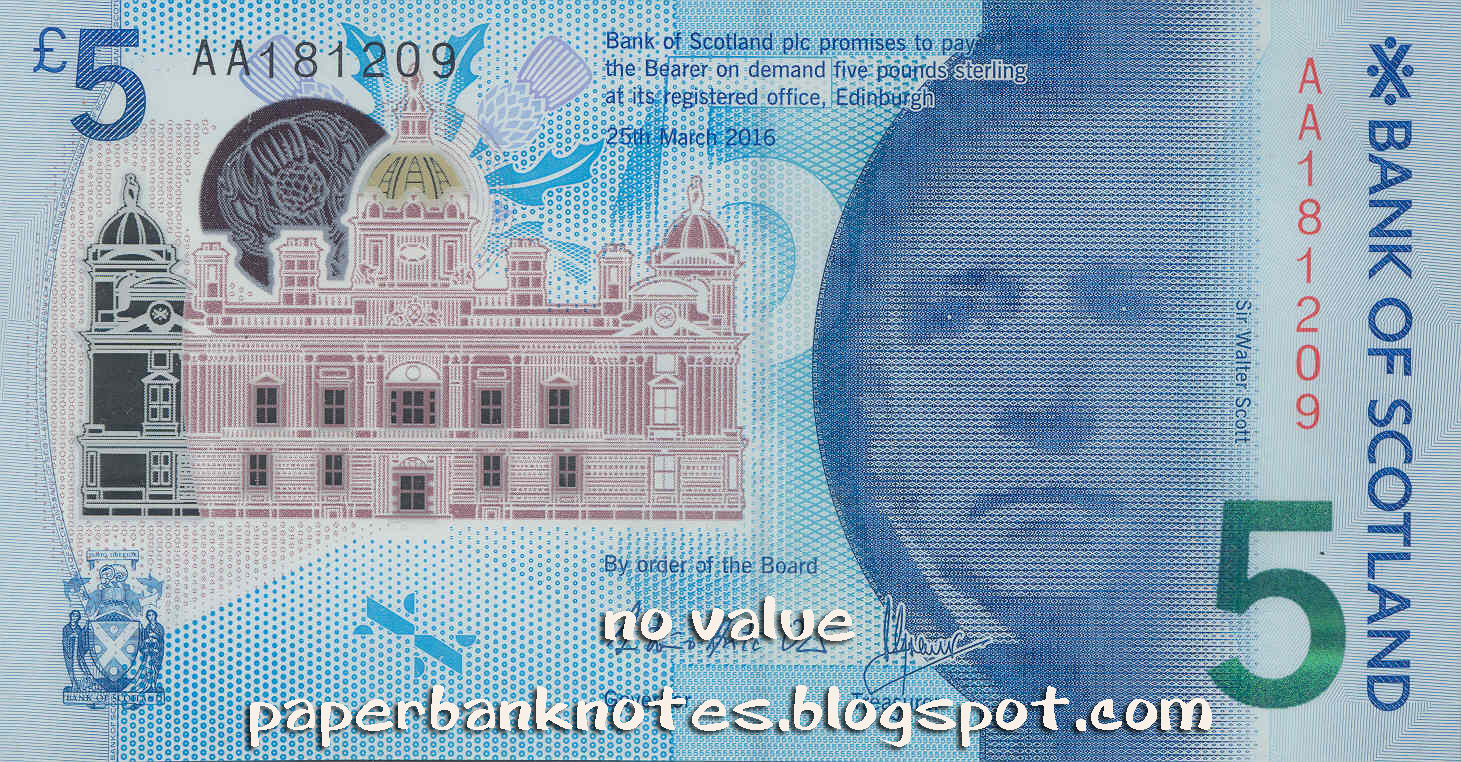
...Scotland, Bank of Scotland - £5 2016 Polymer Series

This is the new polymer series of banknotes issued on 04.10.2016. This note is printed with the date of 25.03.2016. The design for this note is similar to the 2007 paper series except that this polymer note incorporates see-through window security features. The signatures on this note belong to Antonio Mota de Sousa Horta-Osorio (Governor) and Philip Grant (Treasurer). The size for the new series is also smaller than the paper print. The note is measured at 120mm x 66mm as compared to the paper note of 136mm x 70mm. Going forward, we also expect the size of the new £10 note 2017 to be smaller than the paper note too. The first prefix for this series is AA with a replacement prefix printed with ZZ. Of the two Scottish bank polymer issues recently, it seems that the Bank of Scotland replacement notes are much harder to find. Perhaps the replacement note for the Bank of Scotland only comes in as an insert rather than by the bundle. There are no replacement notes printed or reported yet for the 2016 Clydesdale Bank polymer note.

Five Pounds (AA First prefix)
Dated 2016, AA Prefix, P130a
Reverse
Five Pounds (ZZ Replacement Note)
Dated 2016
Reverse


Scotland, Bank of Scotland - 2014 Reprint

One Hundred Pounds
Dated 19.08.2014
Reverse - 90mm x 163mm
This is the latest known Bank Of Scotland note issued with the year date of 2014. This is also the third reprint for this denominationsince the Bridge series was first introduced in 2007 (2009 and 2011). Since the introduction of this Bridge series, only two full sets of 5 notes have been released, first in 2007 and then in 2009. This 2014 £100 note bears the signatures of Antonio Mota de Sousa Horta-Osorio (Governor) and Philip Grant (Treasurer). Bank of Scotland is a wholly owned subsidiary of the Lloyds Banking Group. Antonio Horta-Osorio is also the Chief Executive of the Lloyds Banking Group since 2011.